Nocturnal

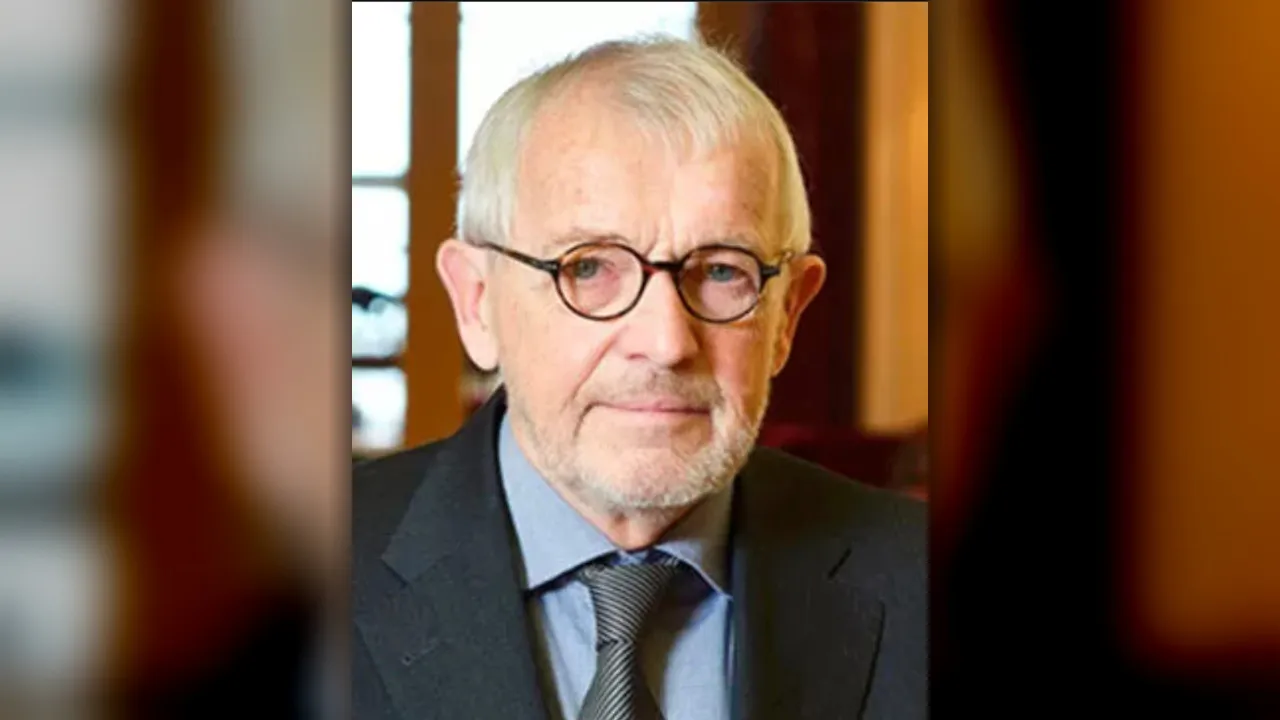
A scientist who spent decades trying to catch “ghost particles” at the bottom of the world has just won physics’ biggest prize.
Francis Halzen, a Belgian-born physicist, has been awarded the 2026 Nobel Prize in Physics for his pioneering work on the IceCube Neutrino Observatory, as first reported by the BBC and Reuters. The announcement was made in Stockholm on Tuesday 6 October by the Royal Swedish Academy of Sciences.
Halzen, who is now a US citizen based at the University of Wisconsin–Madison, is the founder and principal investigator of IceCube, the world’s largest neutrino detector, according to The Print. He first put forward his vision for detecting neutrinos at the South Pole back in 1988.
“I have to emphasise how lucky I was. Because when we started this project, everybody realised this was maybe a good idea, but very few thought it would work, including myself,” he told a news conference, as quoted by the BBC.
What is IceCube actually detecting?
Neutrinos are subatomic particles so elusive they’re often nicknamed “ghost particles”. Billions of low-energy neutrinos from the Sun pass harmlessly through an area the size of a fingernail every single second.
IceCube isn’t interested in those. Instead, it hunts for much higher-energy neutrinos flung out by violent events in distant galaxies, far beyond our Solar System.
The observatory is built from thousands of light sensors strung along cables, drilled and frozen into a cubic kilometre of Antarctic ice at the South Pole. Most neutrinos pass straight through without a trace, but occasionally one collides with the ice, producing fast-moving charged particles that give off a telltale blue flash of light.
By studying the pattern and timing of that light, scientists can work out roughly which direction the neutrino came from, effectively using it as a cosmic messenger pointing back towards the extreme event that created it.
“Francis Halzen has led an international team of researchers and engineers who have provided us with a fantastic instrument,” said Prof Mark Pearce, chair of the Nobel Committee for Physics. “His tenacity and scientific vision has paved the way for a new kind of astronomy.”
Why it matters
Ordinary telescopes rely on light, which can be blocked or distorted on its journey across the universe. Neutrinos barely interact with anything, meaning they travel in a near-perfectly straight line from even the most violent, distant cosmic events straight to Earth.
That makes IceCube a completely different kind of telescope, one that can effectively see through places ordinary instruments cannot. Scientists describe this as opening up a new window onto the universe, allowing them to study high-energy processes happening in far-off galaxies that would otherwise remain hidden.
Halzen’s gamble on building a detector inside a vast natural block of Antarctic ice, rather than a conventional lab, is credited with making that kind of observation possible at the scale needed to actually catch these rare particle collisions.
The award comes during World Space Week, with space and astronomy topics trending in the UK this week. For now, Halzen’s win cements neutrino astronomy as one of the most significant tools physicists have for studying the extreme universe, with IceCube continuing its watch beneath the Antarctic ice.